Your first "real" watch is an exciting purchase — and a surprisingly easy one to get wrong. The most common regret is not buying the wrong brand, it is buying a watch that does not suit your wrist or your life: too big, too fragile, too dressy or too loud to wear every day. This guide walks you through the decisions in the right order.
Step 1: Set a realistic budget
Watches span every price imaginable, but for a first watch the sweet spots are clear:
| Budget | What you get | Examples of the level |
|---|---|---|
| Under $100 | Reliable quartz or digital, basic materials | Casio, Timex Weekender, Casio Duro |
| $100–$300 | Entry automatics, solar quartz, tough G-Shocks | Seiko 5 Sports, Orient Bambino, Citizen Eco-Drive |
| $300–$1,000 | Sapphire crystals, better finishing, Swiss entry-level | Tissot PRX, Hamilton Khaki Field, Seiko Presage, microbrands |
| $1,000–$3,000 | Excellent build, long power reserves, brand heritage | Seiko Prospex, Christopher Ward, Oris, Longines, Sinn |
| $3,000+ | Luxury brands, in-house movements, strong resale | Tudor, Omega, Grand Seiko, Rolex |
Two budget rules we recommend: first, remember to add roughly 10–20% for a second strap and eventual servicing on mechanical watches. Second, do not stretch into debt for a "status" watch as your very first purchase — you will learn a lot about your own taste in the first year, and that knowledge is worth more than a logo. Our first watches by budget list has specific picks at every level.
Step 2: Match the watch to your life
Be honest about how you spend your week. The best first watch is the one you can wear 90% of the time without thinking about it.
- Office and business casual — a clean steel sports watch or a simple three-hander on a bracelet. Think field watch, integrated-bracelet sport watch or a modest diver.
- Active, outdoors, gym — at least 100 m water resistance, screw-down crown, sapphire or tough mineral crystal, a rubber or NATO strap. A diver or G-Shock suits you.
- Formal events and suits — a thin dress watch on leather. But as a first watch, a dress watch is limiting unless your life is genuinely formal.
- Frequent travel — consider a GMT to track home time.
- Hands-on work — builders, mechanics and nurses should prioritise shock resistance and easy cleaning: a G-Shock, a solar Citizen or a rugged field watch.
Imagine wearing the watch to a job interview, a beach holiday and a wedding. If it can plausibly do all three, it is an excellent first watch. A steel diver or sport watch on a bracelet passes this test better than anything else. More ideas: the one-watch collection.
Step 3: Get the size right
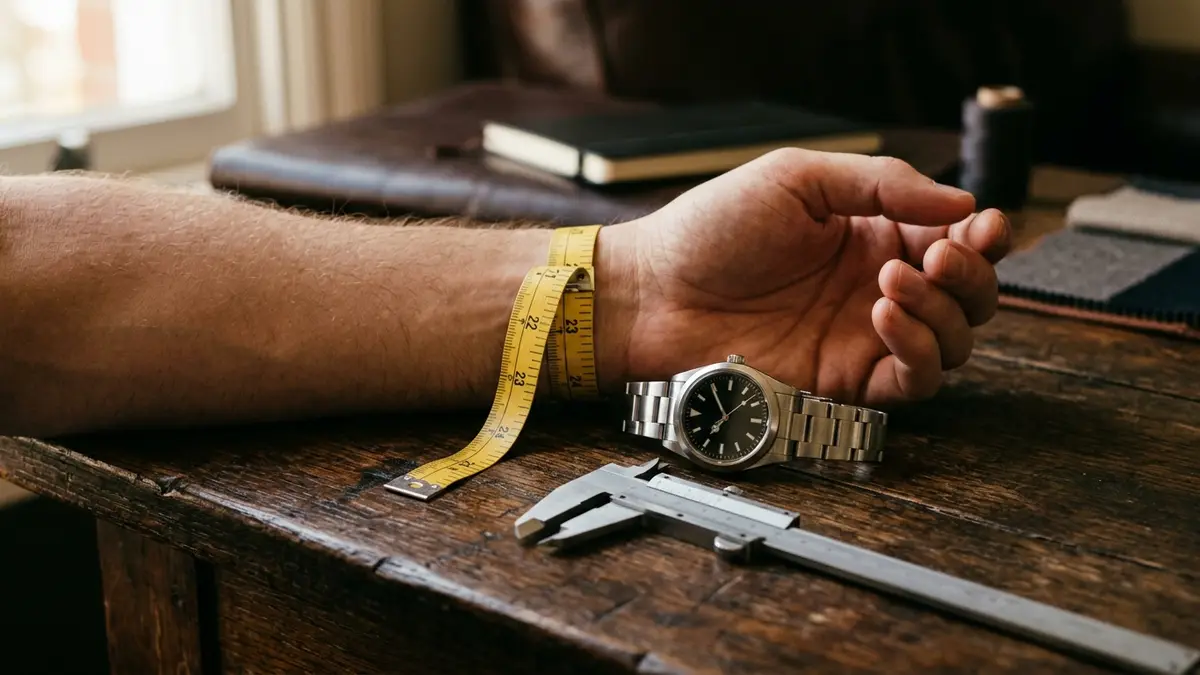
Size is where most beginners go wrong, usually by buying too big. Measure your wrist circumference with a soft tape measure or a strip of paper just below the wrist bone. Then use this rough guide:
| Wrist circumference | Comfortable case diameter | Max lug-to-lug |
|---|---|---|
| Under 16 cm (6.3 in) | 34–39 mm | ~46 mm |
| 16–17.5 cm (6.3–6.9 in) | 38–41 mm | ~49 mm |
| 17.5–19 cm (6.9–7.5 in) | 40–43 mm | ~52 mm |
| Over 19 cm (7.5 in) | 42–46 mm | ~55 mm |
For a personalised answer, use our free watch size calculator. And remember that thickness counts: a 40 mm watch that is 15 mm tall will feel bigger than a 42 mm watch that is 11 mm tall.
Step 4: Choose mechanical or quartz
This is partly practical and partly emotional.
Choose quartz or solar if…
- You want perfect accuracy with no effort
- You'll rotate between watches and hate resetting them
- You want the most features per dollar
- You want minimal servicing costs
Choose mechanical if…
- You love the idea of a tiny machine on your wrist
- You enjoy the smooth sweep of the seconds hand
- You accept ±10–20 seconds a day
- You're fine servicing every 5–10 years
Neither is "better". Read our full comparison in mechanical vs quartz.
Step 5: Pick a style that will last
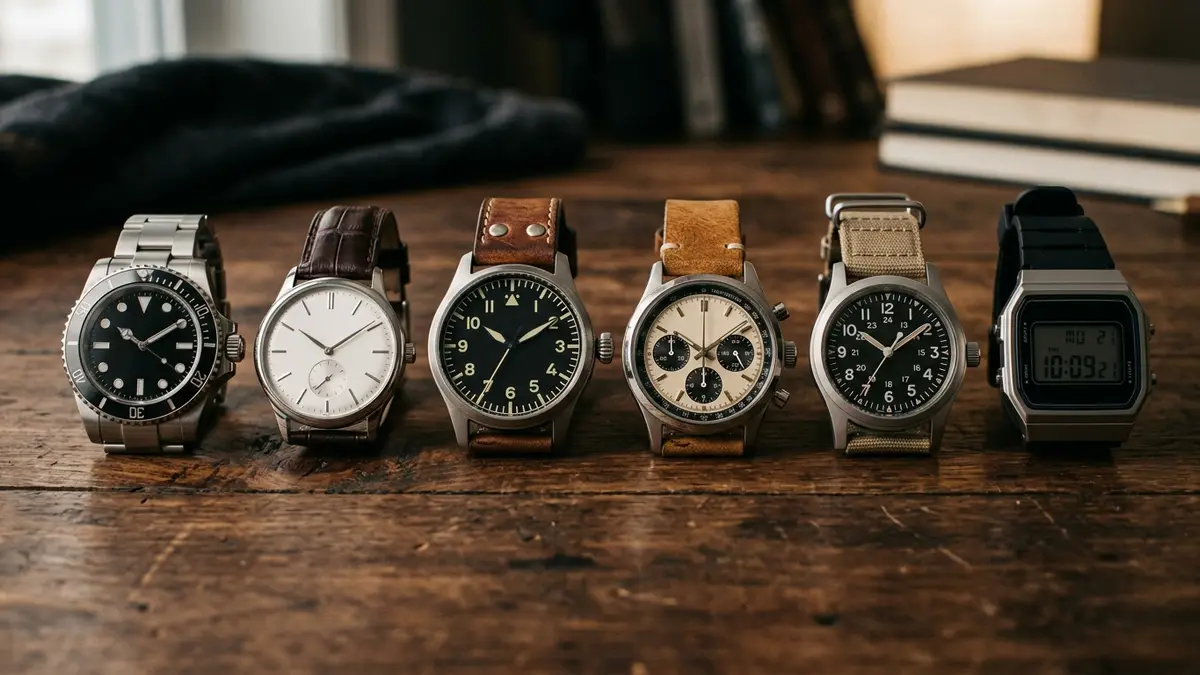
Trends come and go — oversized 46 mm watches were everywhere in 2010 and look dated now. For a first watch, choose design fundamentals that age well:
- Neutral dial colours: black, white, silver, navy, or a muted green or grey.
- Steel case: it goes with everything, from jeans to a suit.
- Legible layout: clear markers and hands. If you can't read it at a glance, you'll stop wearing it.
- A bracelet plus a strap: two looks for the price of one.
Where to buy your first watch
Buy from an authorised dealer or the brand's own website for full warranty, or from a reputable pre-owned dealer with a return policy. Avoid marketplace listings that seem too cheap — counterfeits are common even at modest prices. Our guide on how to spot a fake watch will keep you safe.
Try watches on in person if you can, even if you later buy online. Five minutes on the wrist tells you more than hours of photos.
Beginner mistakes to avoid
- Buying too big because it "looks impressive" in photos.
- Choosing a delicate dress watch as your only watch.
- Ignoring lug-to-lug and thickness.
- Paying for a "limited edition" that is really just a colour change.
- Assuming 30 m water resistance means you can swim — it doesn't. See myths and mistakes.
- Buying a watch with lots of subdials you'll never use.
Not sure where to start? Our watch finder asks five quick questions and matches you with real models.
FAQ
How much should I spend on my first watch?
Most people are best served between $150 and $1,000. That buys a well-made automatic or a premium quartz with sapphire crystal from a reputable brand, leaving room to learn your taste before spending more.
What is the most versatile first watch?
A stainless-steel sports watch around 38–41 mm with 100 m+ water resistance and a neutral dial — such as a modest diver, a field watch or an integrated-bracelet sports watch — covers the widest range of situations.
Should my first watch be automatic?
Only if the idea of a mechanical watch excites you. Quartz and solar watches are more accurate and cheaper to own; automatics offer craftsmanship and character. Both make excellent first watches.