Setting a watch sounds trivial, but doing it wrong is one of the most common causes of avoidable damage to mechanical watches. A few minutes learning the correct technique protects your watch for life.
Understanding crown positions
Most watches have a crown with two or three positions:
| Position | Automatic/manual time-and-date watch | Quartz watch |
|---|---|---|
| 0 (pushed in) | Hand winding | Normal running |
| 1 (first click) | Quick-set date (and on some, day) | Quick-set date |
| 2 (second click) | Set time; often stops seconds hand ("hacking") | Set time |
On a GMT, position 1 usually moves the local hour hand or the GMT hand. On watches without a date, there may be only two positions. Always check your manual.
Screw-down crowns
- Unscrew anticlockwise (towards you) until the crown springs out to position 0.
- Wind or pull out to set as needed.
- Push the crown back in and, while pressing gently, screw it clockwise until snug. Don't overtighten.
An unscrewed crown leaves the watch vulnerable to water and dust. Make it a habit — especially before swimming.
How to wind a manual watch
- Take the watch off to avoid bending the stem.
- With the crown in position 0, turn it clockwise (away from you) with smooth strokes.
- From empty, 20–40 turns is typical. Stop when you feel firm resistance.
- Wind once a day, at roughly the same time — mornings are best.
How to wind an automatic watch
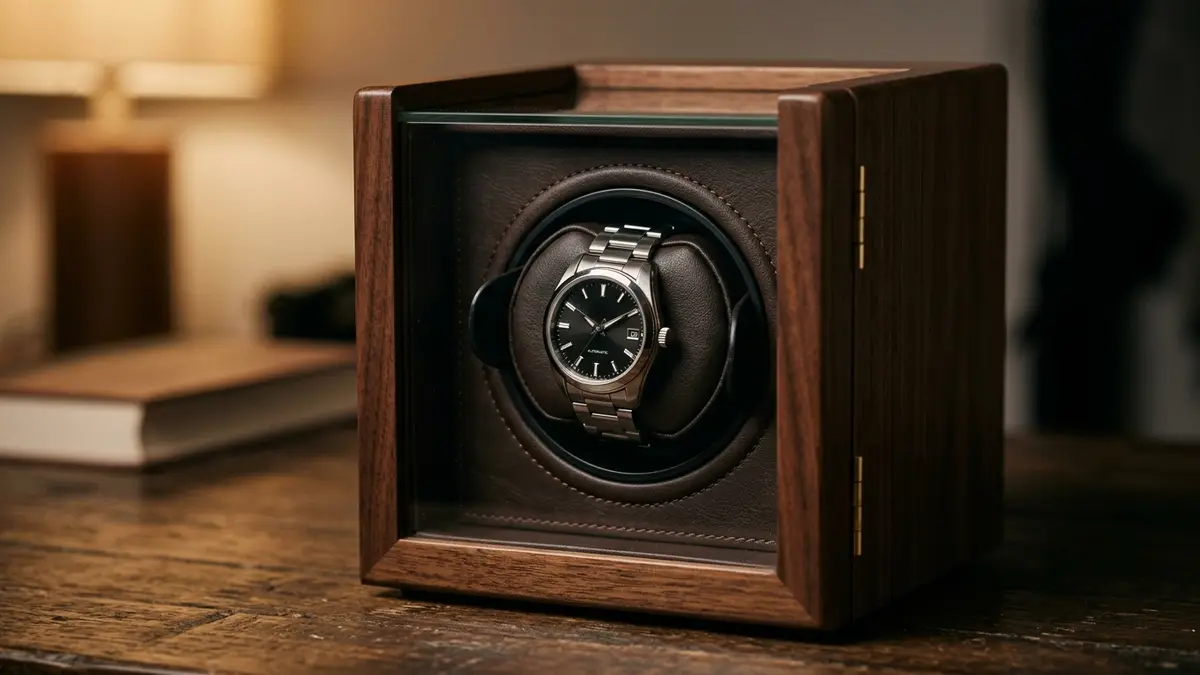
If worn daily, an automatic winds itself. If it has stopped, or if you've been sitting at a desk, give it 20–40 turns in position 0 to start it with a full reserve. Automatics can't be overwound. If your automatic can't be hand-wound (some older budget movements), gently swing it side to side for 30 seconds to start it. Read more about automatic watches.
How to set the time and date correctly
Here's the safe order for a mechanical watch with a date:
- Wind the watch so it's running.
- Pull the crown to position 2 (time setting).
- Move the hands to 6:30 — safely away from the date-change mechanism.
- Push to position 1 and quick-set the date to yesterday's date.
- Pull back to position 2 and advance the hands forward through midnight until the date clicks over to today's date. You're now in the AM.
- Continue forward to the correct time (add 12 hours if it's afternoon).
- For precision, stop the seconds hand at 12 (if it hacks), and push the crown in exactly on a time signal.
- Push the crown in and screw it down if applicable.
Tip: Always move the hands forward when possible. Many movements handle backward setting fine, but moving forward is universally safe.
The date "danger zone"
On most mechanical watches, the date-change mechanism begins engaging a few hours before midnight and completes a little after. If you use the quick-set date while those gears are engaged, you can damage teeth on the date wheel or the change mechanism.
The exact window varies by movement (some specify 8 pm–4 am; some modern calibers have no danger zone at all). The safe habit: set the time to around 6 o'clock before changing the date.
Quartz watches generally don't have this problem, but following the same habit does no harm.
Setting other complications
- Day-date: the day is often set by turning the crown the opposite way in position 1. Set it with the hands at 6.
- GMT: set the GMT hand to home time using the 24-hour scale, then set local time. See GMT watches.
- Moonphase: use a pusher or corrector and a moon calendar; start from the last full moon.
- Annual/perpetual calendars: follow the manual precisely or have a dealer set it.
- Chronograph: never set the time or reset while the chronograph is running; stop it first.
Quick-reference checklist
- ✔ Take the watch off to wind and set.
- ✔ Set hands to 6 before changing the date.
- ✔ Move hands forward.
- ✔ Never operate the crown or pushers underwater.
- ✔ Screw the crown back down.
FAQ
Can I turn the hands backwards on my watch?
On most modern watches, yes, briefly — but moving forward is always safe. Avoid turning backwards through the date-change window on older or complicated watches.
How long can a watch sit before I need to reset it?
That depends on its power reserve — typically 38–80 hours for a mechanical watch. Quartz and solar watches keep running for months or years.