A chronograph is a watch with a built-in stopwatch. Press a pusher and a central seconds hand starts sweeping; subdials count the minutes and hours. It's one of the most useful and most beloved complications, strongly linked to motorsport, aviation and space exploration.
History
The first chronograph was built by Louis Moinet in 1816 to track astronomical observations; Nicolas Rieussec's 1821 device literally "wrote time" with ink, giving the name (Greek chronos = time, graph = writing). Wrist chronographs arrived around 1913–1915 thanks to Longines and Breitling, which also introduced the separate reset pusher.
The 1960s were the golden age: the Omega Speedmaster was qualified by NASA and went to the moon in 1969; the Heuer Carrera (1963) and Rolex Daytona (1963) were born for racing. In 1969, the race to build the first automatic chronograph ended in a near tie between Zenith's El Primero, the Heuer–Breitling–Hamilton "Chronomatic" Calibre 11 and Seiko's 6139.
How a chronograph works
- Top pusher (2 o'clock) — start and stop.
- Bottom pusher (4 o'clock) — reset to zero (only when stopped).
- Central seconds hand — measures elapsed seconds.
- Subdials — typically a 30-minute counter, a 12-hour counter and a running seconds dial.
Mechanical chronographs use either a traditional column wheel (smoother, prized by enthusiasts) or a cam system (robust, cheaper). A vertical clutch prevents hand stutter on start and lets you run the chronograph continuously without extra wear.
How to use a tachymeter
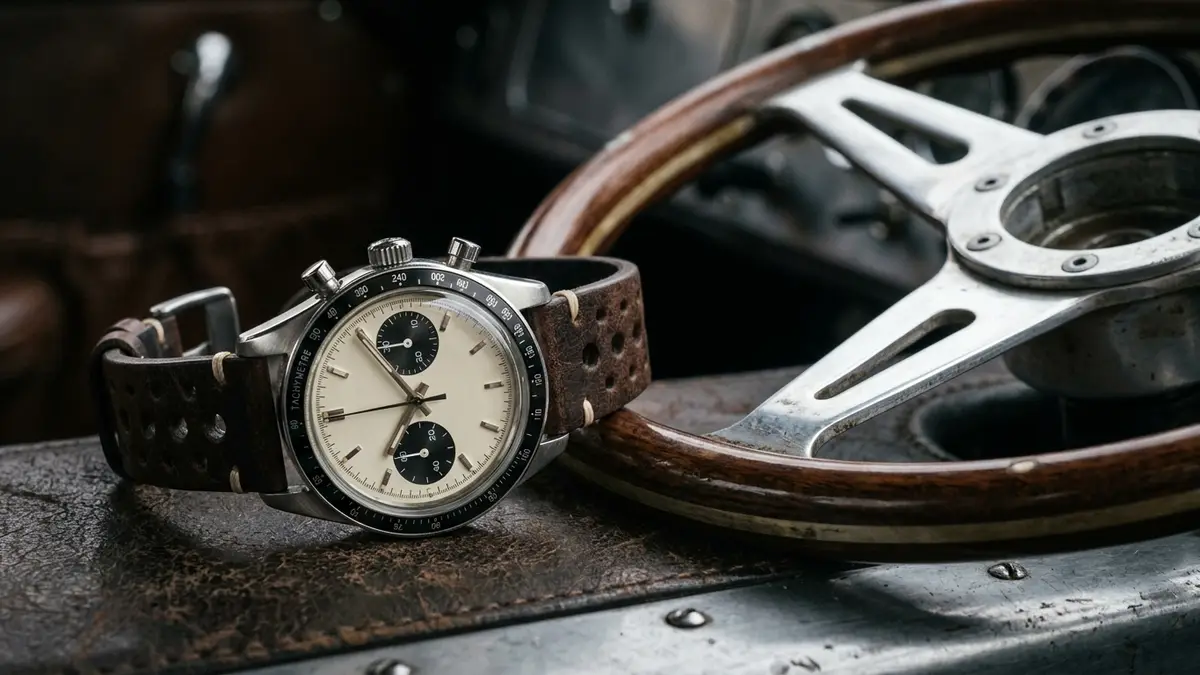
The tachymeter scale on the bezel converts elapsed time over a known distance into speed. Start the chronograph at a kilometre (or mile) marker and stop it at the next. The number the seconds hand points to on the tachymeter is your speed in km/h (or mph). Example: 1 km in 30 seconds → the hand points to 120 → 120 km/h.
Other scales include the telemeter (distance to a storm or artillery using the speed of sound) and pulsometer (heart rate — used by doctors).
Characteristic styles
- Panda dial — white dial with black subdials (reverse panda is the opposite).
- Bi-compax / tri-compax — two or three subdial layouts.
- Racing chronographs — tachymeter bezels, perforated "rally" straps, bold accent colours.
- Pilot chronographs — see pilot watches.
Who chronographs suit
Anyone who likes a sporty, technical look, motorsport or aviation — and who'll actually enjoy timing a steak, a parking meter or a lap. Chronographs are thicker and busier than simple watches, so they suit casual and smart-casual wear better than formal. Sleek, slim examples like the Speedmaster can work with a suit.
Iconic chronographs
- Omega Speedmaster Professional "Moonwatch" — manual-wind, flown on every Apollo mission.
- Rolex Cosmograph Daytona — the most coveted sports chronograph.
- TAG Heuer Carrera and Monaco — racing royalty; the Monaco was Steve McQueen's.
- Zenith El Primero / Chronomaster — high-beat 36,000 vph pioneer.
- Breitling Navitimer and Chronomat.
- Seiko Speedtimer — heir to the 6139.
Best chronographs by budget
| Watch | Approx. price | Movement | Why |
|---|---|---|---|
| Casio Edifice / Timex chronograph | ~$100–$150 | Quartz | Affordable sporty look |
| Omega x Swatch MoonSwatch | ~$285 | Quartz | Speedmaster design, fun colours |
| Seagull 1963 | ~$350 | Manual | Mechanical chrono for the price of quartz |
| Bulova Lunar Pilot | ~$700 | High-performance quartz | Moon-flown heritage |
| Hamilton Intra-Matic / Tissot PRX Chrono | ~$1,800–$2,300 | Automatic | Swiss automatic chrono value |
| Omega Speedmaster Professional | ~$7,100 | Manual | The Moonwatch |
| TAG Heuer Carrera | ~$6,000+ | Automatic | Racing heritage |
| Rolex Daytona | ~$16,000+ (retail) | Automatic | The grail |
FAQ
What's the difference between a chronograph and a chronometer?
A chronograph has a stopwatch function. A chronometer is a watch certified for high accuracy (e.g. COSC). A watch can be both.
Can I leave the chronograph running all the time?
On watches with a vertical clutch, yes. On traditional horizontal-clutch chronographs, running it constantly adds wear and reduces amplitude; use it as needed.