Watch talk is full of French, Swiss-German and marketing jargon. This glossary translates the terms you will meet most often on product pages, forums and in shops. Terms are grouped by topic so you can learn related ideas together; use your browser's find function (Ctrl/Cmd + F) to jump to a specific word.
Movement terms
- Movement / Caliber (Calibre) — the mechanism that measures time. "Caliber" is the model designation, e.g. ETA 2824-2 or Seiko NH35.
- Mechanical — powered by a coiled mainspring rather than a battery. Includes manual and automatic.
- Manual wind (hand-wound) — mechanical movement you wind by turning the crown. See manual-wind watches.
- Automatic (self-winding) — mechanical movement wound by a rotor that spins with wrist motion. See automatic watches.
- Quartz — battery-powered movement regulated by a quartz crystal vibrating at 32,768 Hz. Very accurate and low-maintenance.
- Mainspring — the coiled spring that stores energy in a mechanical watch.
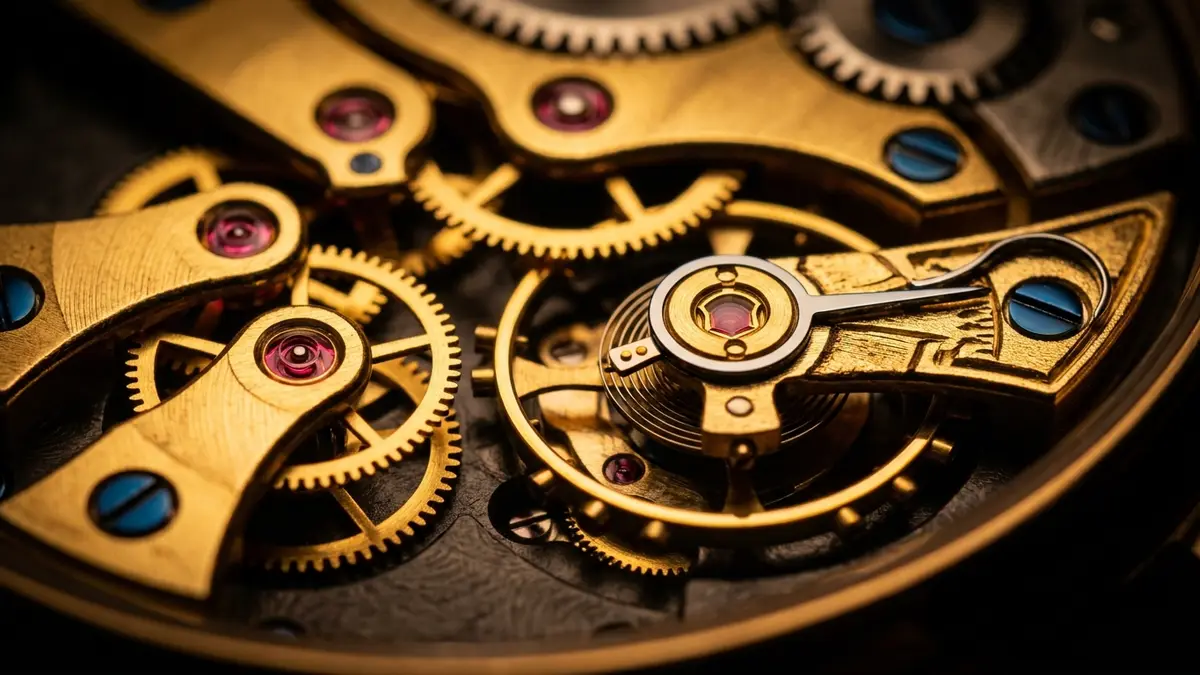
- Balance wheel & hairspring — the oscillating "heart" of a mechanical watch that divides time into equal beats.
- Escapement — the mechanism that releases the mainspring's energy in controlled steps; responsible for the ticking sound.
- Beat rate (frequency) — how fast the balance oscillates, expressed in vibrations per hour (vph) or hertz. 28,800 vph (4 Hz) is common; higher rates produce a smoother sweep.
- Jewels — synthetic rubies used as low-friction bearings. A typical automatic has 21–25. More jewels do not automatically mean better; see watch myths.
- Rotor — the semicircular weight in an automatic that winds the mainspring. A micro-rotor is a small rotor set into the movement to save thickness.
- Power reserve — how long a fully wound watch runs before stopping. 38–42 hours is standard; 70–80 hours is now common in mid-range watches.
- Hacking — the seconds hand stops when you pull the crown out, allowing precise time setting.
- In-house — a movement designed and made by the watch brand itself. See in-house vs base calibers.
- Ébauche — an unfinished base movement bought from a supplier and then finished or modified by a brand.
- Spring Drive — Seiko's hybrid movement: a mainspring powers it, but an electronic regulator controls its speed.
- Eco-Drive / Solar — light-powered quartz movement that charges a rechargeable cell. See solar watches.
- Tourbillon — a rotating cage holding the escapement, invented to average out gravity's effect on accuracy; today mostly a showpiece of skill.
Accuracy and certification
- Seconds per day (s/d) — how much a mechanical watch gains or loses daily. A typical automatic runs within ±10–20 s/d; a well-adjusted one within ±5 s/d.
- COSC — Contrôle Officiel Suisse des Chronomètres, the Swiss testing institute. Certified "chronometers" must run within −4/+6 s/d across 15 days of testing in different positions and temperatures.
- Chronometer — a watch whose movement has passed a precision certification such as COSC. Not to be confused with chronograph.
- METAS / Master Chronometer — a stricter certification used by Omega, testing the cased watch for accuracy (0/+5 s/d) and resistance to magnetism up to 15,000 gauss.
- Superlative Chronometer — Rolex's in-house standard of −2/+2 s/d for the cased watch.
- Regulation / adjustment — fine-tuning a movement's rate. "Adjusted to five positions" means tested dial up, dial down and three crown positions.
- Isochronism — a movement's ability to keep the same rate as the mainspring unwinds.
- Amplitude — how far the balance wheel swings; a key health indicator watchmakers measure on a timegrapher.
- HAQ — high-accuracy quartz, rated to within about ±10 seconds per year.
Complications and functions
- Complication — any function beyond hours, minutes and seconds. Full guide: watch complications.
- Chronograph — a stopwatch function operated by pushers. "Chrono" for short.
- Flyback — a chronograph that can be reset and restarted with one push.
- GMT — displays a second time zone using a 24-hour hand. Named after Greenwich Mean Time. See GMT watches.
- World timer — shows the time in all 24 major time zones at once.
- Moonphase — shows the current phase of the moon.
- Annual calendar — automatically accounts for 30- and 31-day months; needs correction once a year (end of February).
- Perpetual calendar — accounts for all month lengths and leap years, typically correct until 2100.
- Day-date — shows both the weekday and the date.
- Small seconds — seconds displayed in a subdial rather than by a central hand.
- Power reserve indicator — shows how much energy remains in the mainspring.
- Minute repeater — chimes the time on demand with tiny hammers and gongs; among the most expensive complications.
Case, dial and bracelet terms
- Bezel, crown, lugs, crystal, caseback — see anatomy of a watch.
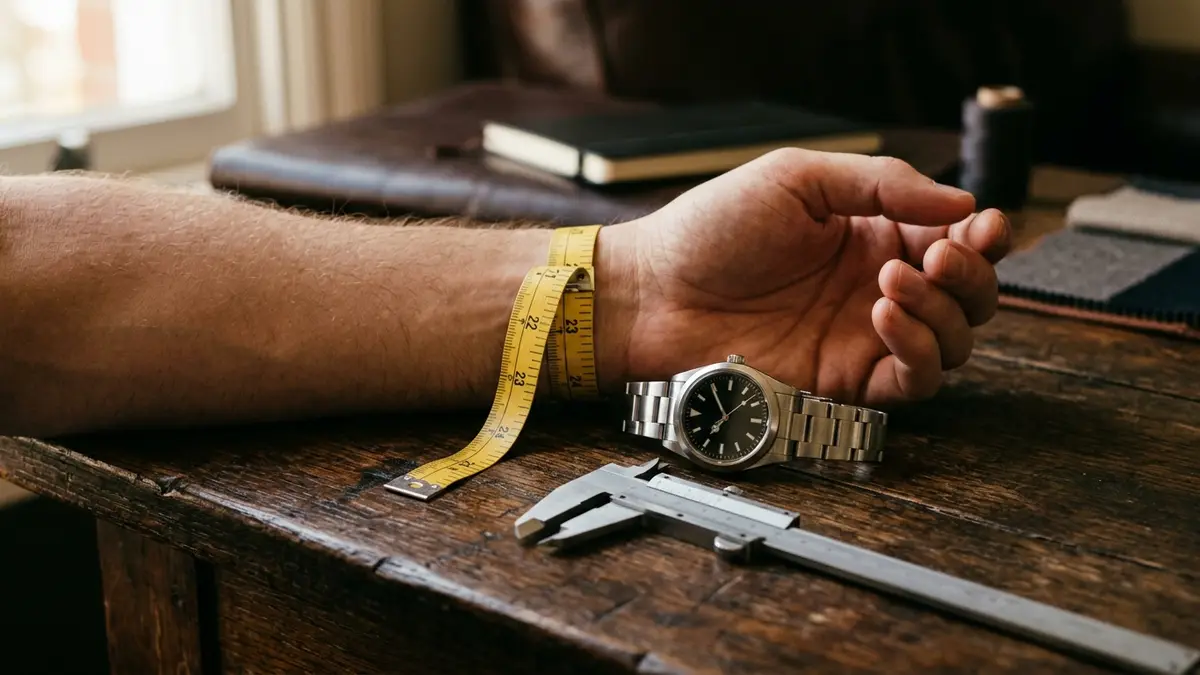
- Lug-to-lug (L2L) — the length of the case from lug tip to lug tip; the key measure of wrist fit.
- Lug width — space between lugs for the strap (e.g. 20 mm).
- Sapphire — synthetic sapphire crystal; extremely scratch resistant.
- AR coating — anti-reflective coating on the crystal.
- Lume — luminous material on hands and indices.
- Applied indices — hour markers made as separate pieces and fixed to the dial.
- Sunburst — a dial finish with lines radiating from the centre that reflect light.
- Guilloché — intricate engraved or stamped geometric patterns on a dial.
- Sandwich dial — two layers with cut-out numerals filled with lume, popular on pilot and military styles.
- Cyclops — a small magnifying lens over the date window.
- Integrated bracelet — a bracelet that flows into the case without visible lugs.
- End links — the bracelet pieces that meet the case.
- NATO strap — a one-piece nylon strap that threads under the watch. See the strap guide.
- PVD / DLC — thin hard coatings (physical vapour deposition, diamond-like carbon) used to colour cases black or gold.
- 316L / 904L steel — grades of stainless steel; 904L (used by Rolex as "Oystersteel") has higher corrosion resistance.
Water resistance terms
- WR — water resistance. The rating is a pressure test result, not a safe diving depth. 30 m = splash-proof; 100 m = swimming; 200 m+ = diving. Details in battery and water resistance.
- ATM / bar — alternative units: 10 ATM or 10 bar ≈ 100 m.
- ISO 6425 — the international standard a watch must meet to be called a "diver's watch".
- Helium escape valve — a valve that lets helium out of the case during decompression for professional saturation divers.
- Screw-down crown — a crown that threads onto the case for a tighter seal.
Market and collector slang
- Grail — a collector's ultimate dream watch.
- Beater — a tough, inexpensive watch you wear without worry.
- Homage — a watch closely inspired by a famous design, usually much cheaper. Not the same as a fake — see how to spot a fake.
- Microbrand — a small, often online-only independent brand. See microbrands.
- AD — authorised dealer, a retailer officially licensed by a brand.
- Grey market — new watches sold outside the official dealer network, often discounted.
- Full set — a watch sold with its original box, papers and accessories. Important for resale — see watches as an investment.
- Patina — ageing of dials, lume or metal that collectors often value in vintage pieces.
- Frankenwatch — a watch assembled from parts of different watches, usually undisclosed.
- Wrist roll — a short video or photo series showing a watch on the wrist from several angles.
Chronograph = stopwatch function. Chronometer = certified accuracy. A watch can be both, either or neither.
FAQ
What does "caliber" mean on a watch?
Caliber (or calibre) is the name or number of a watch movement model, such as ETA 2824-2, Seiko NH35 or Rolex 3235. It tells you exactly which engine is inside the watch.
What does 21 jewels mean?
It means the movement uses 21 synthetic ruby bearings to reduce friction at key pivot points. It is a normal figure for an automatic movement and not, on its own, a sign of quality.
Is a GMT the same as a dual-time watch?
Both show two time zones. A GMT typically uses a 24-hour hand and bezel, while a "dual time" can mean any second time display, such as a subdial or a second set of hands.