An automatic watch is a mechanical watch that winds itself. Inside is a semicircular weight — the rotor — that spins as you move your arm. Through a set of reduction gears, that spinning tightens the mainspring. As long as you wear the watch regularly, it keeps running without you ever touching the crown. It is the most popular mechanical watch type in the world.
A brief history
Self-winding pocket watches existed in the 18th century, but the wristwatch version took off in the 1920s with John Harwood's "bumper" automatic. In 1931 Rolex patented the Perpetual rotor, which turned a full 360 degrees and became the template for virtually every automatic since. Today automatics range from the $150 Orient Bambino to haute horlogerie masterpieces.
How it works, step by step
- Wrist movement swings the rotor around its central pivot.
- A reverser or "magic lever" system converts the rotor's motion (in one or both directions) into winding rotation.
- The winding gears tighten the mainspring in its barrel.
- A slipping bridle stops the mainspring from overwinding once full.
- The mainspring powers the gear train, regulated by the escapement and balance wheel, exactly like a manual-wind watch.
Most modern automatics can also be wound by hand through the crown — useful for starting a stopped watch. Some budget movements, like older Seiko 7S26, cannot be hand-wound or hacked.
Power reserve and wearing habits
A fully wound automatic will keep running off the wrist for its power reserve — typically:
| Movement | Found in | Power reserve | Frequency |
|---|---|---|---|
| Seiko NH35 / 4R35 | Seiko 5, many microbrands | ~41 h | 21,600 vph |
| Miyota 8215 / 9039 | Citizen, microbrands | ~42 h | 21,600 / 28,800 vph |
| ETA 2824-2 / Sellita SW200-1 | Swiss mid-range brands | ~38–41 h | 28,800 vph |
| Powermatic 80 / H-10 | Tissot, Hamilton, Certina, Mido | ~80 h | 21,600 vph |
| Seiko 6R35 | Prospex, Presage | ~70 h | 21,600 vph |
| Rolex 3235 / Tudor MT5402 | Submariner, Black Bay 58 | ~70 h | 28,800 vph |
With a 70–80 hour reserve, you can take the watch off on Friday evening and it will still be running on Monday morning — a real quality-of-life upgrade.
If you sit at a desk all day, your automatic may not receive enough motion to stay fully wound. Giving it 20–30 turns of the crown each morning keeps accuracy consistent.
Do you need a watch winder?
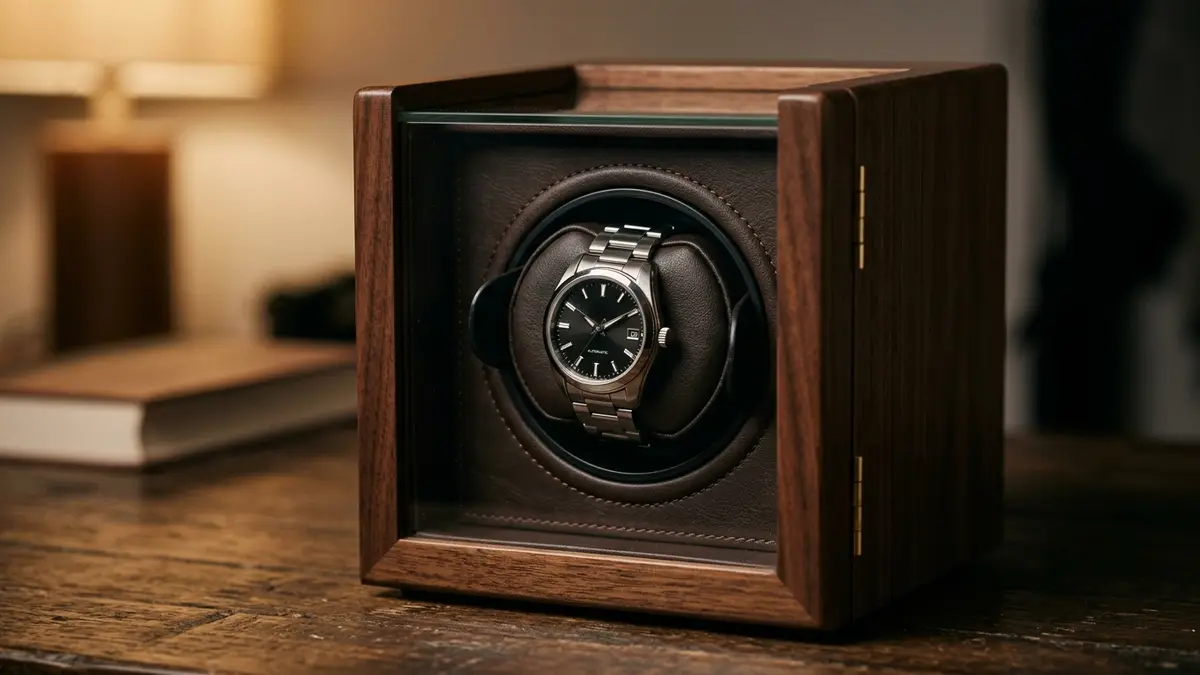
A watch winder is a box that gently rotates an automatic to keep it wound when you're not wearing it. It's a convenience, not a necessity. They make sense for complicated watches like perpetual calendars or moonphases that are tedious to reset. For simple time-and-date watches, just set the watch when you pick it up. More in storage and winders.
Pros and cons of automatics
Pros
- No battery, no daily winding if worn regularly
- Smooth sweeping seconds hand
- Long lifespan and repairable
- Huge choice at every price
Cons
- Less accurate than quartz
- Thicker than hand-wound equivalents
- Stops if unworn beyond the power reserve
- Needs periodic servicing
Signs of a quality automatic
- Hacking seconds for precise time setting.
- Hand-winding capability.
- A long power reserve (60 hours or more).
- Anti-magnetic components such as silicon hairsprings.
- Chronometer certification (COSC, METAS) or a stated accuracy tolerance.
FAQ
Can you overwind an automatic watch?
No. Automatics have a slipping clutch on the mainspring that prevents overwinding, whether from the rotor or the crown.
What happens if my automatic stops?
Nothing harmful. Wind it with 20–40 turns of the crown (or shake it gently if it can't be hand-wound), then set the time and date.
How accurate is an automatic watch?
Typically within ±10–20 seconds per day for entry movements and within ±2–6 seconds per day for chronometer-certified ones.