In watchmaking, a complication is any function beyond simply showing hours, minutes and seconds. The term comes from the fact that each extra function literally complicates the movement: more parts, more assembly, more skill. Complications range from the humble date window to the extraordinary minute repeater, which chimes the time on tiny gongs.
Everyday complications
Date
The most common complication: a rotating disc displaying the date through a window. Simple date wheels don't know month lengths, so you'll correct them at the end of 30-day months and February. Tip: never adjust the date on a mechanical watch between about 9 pm and 3 am — see how to set a watch.
Day-date
Adds the day of the week — sometimes spelled out in full at the top of the dial, as on the Rolex Day-Date, or in a window next to the date.
Power reserve indicator
A gauge showing how much energy remains in the mainspring. Especially useful on manual-wind watches.
Timing complications
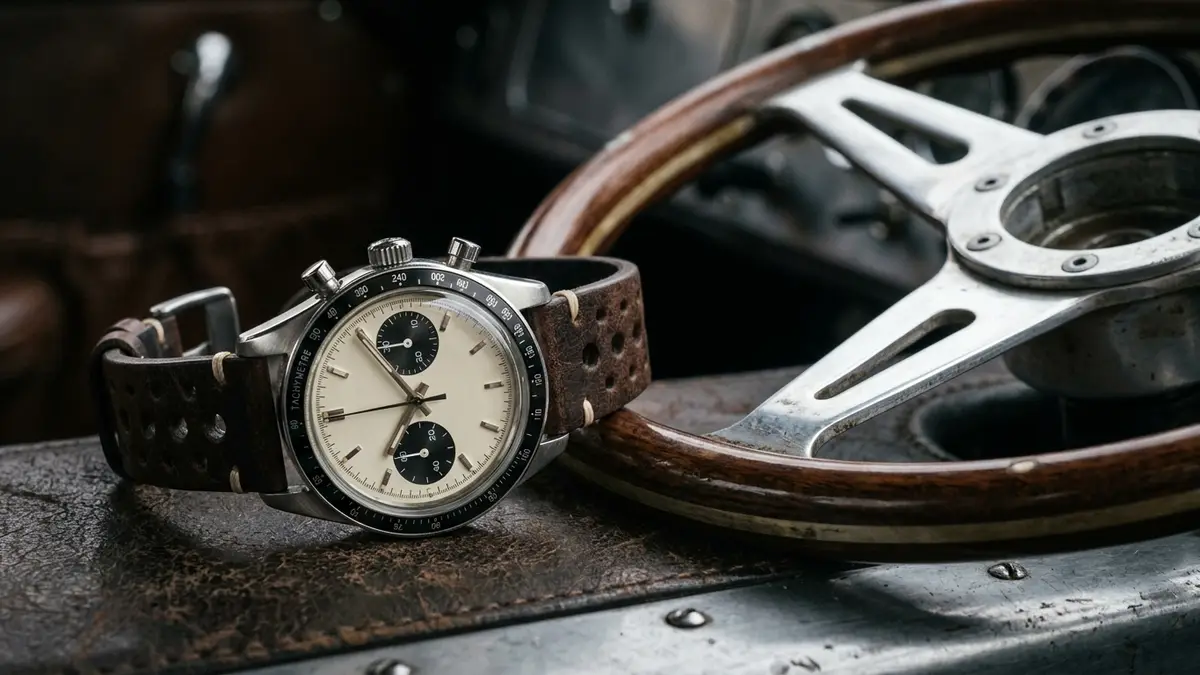
Chronograph
A stopwatch built into the watch, started, stopped and reset with pushers. Subdials count elapsed minutes and hours. Variants include:
- Flyback — reset and restart instantly with one push, originally for pilots.
- Rattrapante (split-seconds) — two seconds hands to time two events simultaneously; highly complex.
- Mono-pusher — start, stop and reset with a single button.
More in our guide to chronograph watches.
Travel complications
GMT
An extra hand that makes one revolution every 24 hours, read against a 24-hour bezel or scale, shows a second time zone. "Flyer" GMTs let you jump the local hour hand; "caller" or "office" GMTs let you jump the GMT hand. See GMT watches.
World timer
Shows the time in all 24 main time zones at once, using a rotating 24-hour ring and a city ring. Invented by Louis Cottier in the 1930s and now a prized complication.
Astronomical and calendar complications
Moonphase
A disc painted with two moons rotates beneath an aperture to show the moon's phase. A standard moonphase is accurate to about one day every 2.5 years; "astronomical" versions stay correct for over 100 years.
Annual calendar
Knows the difference between 30- and 31-day months, so it only needs adjustment once a year, at the end of February. Patek Philippe patented the first wristwatch annual calendar in 1996.
Perpetual calendar
Accounts for every month's length and leap years automatically, typically needing no correction until 2100 (which, unusually, is not a leap year). A masterpiece of mechanical programming using a 48-month cam.
Haute horlogerie complications
Tourbillon
Patented by Abraham-Louis Breguet in 1801, the tourbillon places the escapement and balance in a rotating cage (usually one turn per minute) to average out the effect of gravity in pocket watches that sat in one position. On a wristwatch, which constantly changes position, its accuracy benefit is debated — but as a mesmerising display of skill it's unmatched.
Minute repeater
Slide a lever and the watch chimes the time: low tones for hours, high-low pairs for quarter hours, high tones for minutes. Tuning the gongs by hand takes rare expertise; prices typically start in six figures.
Grande complication
A watch combining several major complications — typically a perpetual calendar, chronograph and minute repeater.
Complications at a glance
| Complication | Usefulness | Typical entry price |
|---|---|---|
| Date / day-date | High | Under $50 |
| Chronograph | Medium–high | ~$100 (quartz), ~$350 (mechanical) |
| GMT | High for travellers | ~$400 |
| Moonphase | Low (aesthetic) | ~$200 (quartz), ~$1,000 (mechanical) |
| World timer | Medium for travellers | ~$1,000+ |
| Annual calendar | Medium | ~$5,000+ |
| Perpetual calendar | Medium | ~$10,000+ (quartz far less) |
| Tourbillon | Low (showpiece) | Low thousands (Chinese) to six figures |
| Minute repeater | Low (showpiece) | Six figures |
How many complications do you need?
For daily life: a date, and maybe a GMT if you travel. Everything else is joy, art and engineering. Choose complications you'll actually use or that genuinely delight you — they add cost, thickness and servicing complexity.
FAQ
What is the most useful watch complication?
For most people, the date. For frequent travellers, a GMT. For timing things, a chronograph.
What is the most complicated watch ever made?
Record holders include Vacheron Constantin's Berkley Grand Complication pocket watch (63 complications) and Patek Philippe's Calibre 89. For wristwatches, Patek's Grandmaster Chime is among the most complex.