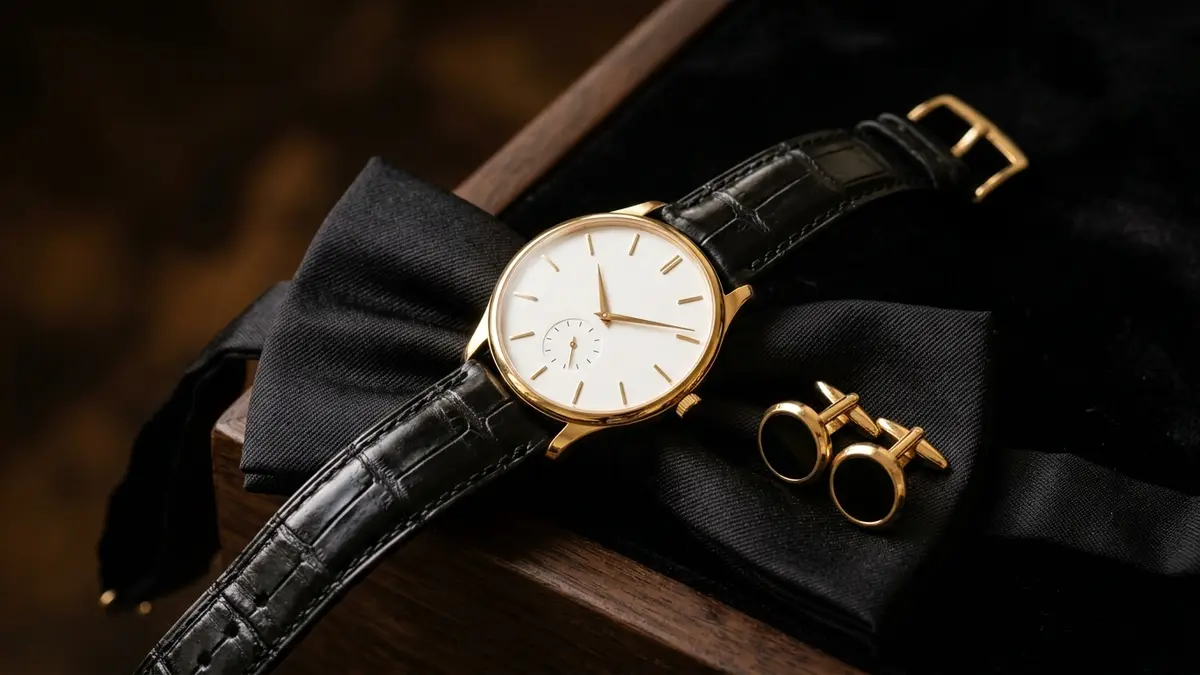
A dress watch is the tuxedo of the watch world: thin, simple, elegant and designed to slip discreetly under a shirt cuff. Its purpose is not to be a tool but to be a quiet signal of taste. In a world of large sports watches, a fine dress watch has become a sophisticated choice.
History
Early wristwatches were almost all dress watches by today's standards: small, elegant and made in precious metals. Cartier's Santos (1904) and Tank (1917) established the elegant men's wristwatch. Patek Philippe's Calatrava reference 96 (1932), inspired by Bauhaus simplicity, defined the round dress watch archetype. Jaeger-LeCoultre's Reverso (1931) was designed for polo players to flip the dial and protect it. Through the 20th century, ultra-thin movements from houses like Piaget and Vacheron Constantin pushed elegance even further.
Characteristic features
- Thin case — ideally under 10 mm, the thinner the better, so it slides under a cuff.
- Moderate size — 34–40 mm for most wrists.
- Clean dial — white, silver, cream, black or deep blue; applied baton or Roman indices; perhaps small seconds. No bezel scales.
- Leather strap — black or dark brown, often alligator or calf; matched to your shoes and belt.
- Precious or polished metals — gold, platinum or polished steel.
- Minimal complications — perhaps a date, moonphase or small seconds, but never a busy dial.
- Modest water resistance — often 30 m. This is not a swimming watch.
Who dress watches suit
Anyone who regularly wears suits, attends formal events, works in law, finance or diplomacy, or simply appreciates understated elegance. As a first and only watch it can be limiting — it doesn't like water, sports or rough handling. It's the ideal second watch after a versatile sports watch. For formal etiquette, see watches and dress codes.
Iconic dress watches
- Patek Philippe Calatrava — the definitive round dress watch.
- Cartier Tank — the rectangular icon, worn by everyone from Andy Warhol to Princess Diana.
- Jaeger-LeCoultre Reverso — Art Deco and reversible.
- A. Lange & Söhne Saxonia and 1815 — German haute horlogerie.
- Vacheron Constantin Patrimony — minimalist perfection.
- Rolex Cellini / 1908 — Rolex's dress line.
- Grand Seiko Elegance — Japanese craft and dial artistry.
Best dress watches by budget
| Watch | Approx. price | Why |
|---|---|---|
| Casio MQ-24 / A158 style quartz | ~$20–30 | Slim and surprisingly elegant on a budget |
| Orient Bambino | ~$160 | Domed crystal, automatic, vintage charm |
| Timex Marlin Hand-Wound | ~$250 | Mid-century reissue, hand-wound |
| Seiko Presage Cocktail Time | ~$450 | Gorgeous textured dials |
| Tissot Everytime / Le Locle | ~$300–$700 | Swiss, slim, classic |
| Junghans max bill | ~$800–$1,300 | Bauhaus design icon |
| Nomos Tangente | ~$2,100 | 6.8 mm thin, in-house movement |
| Cartier Tank Must | ~$3,300 | An icon at an entry luxury price |
| Grand Seiko Elegance | ~$5,000+ | Exquisite finishing |
| Patek Philippe Calatrava | ~$30,000+ | The ultimate |
Dress watch rules worth following
- Match your leathers — black strap with black shoes, brown with brown. See style rules.
- Match your metals — gold case with gold cufflinks and belt buckle.
- Keep it thin — if the watch catches your cuff, it's too thick.
- Size down — a dress watch can be 2–3 mm smaller than your sports watch.
- No rubber, NATO or loud colours for formal wear.
FAQ
What size should a dress watch be?
For most men, 36–39 mm is ideal, and thickness under 10 mm. Smaller wrists can go down to 34 mm; very large wrists up to about 40–41 mm.
Can a dress watch be worn every day?
Yes, in an office environment. Just avoid swimming, sports and heavy manual work, and keep it away from water unless the water resistance allows it.