Most watch damage happens not on the wrist but through careless storage — watches knocking together in a drawer, sitting next to magnets or baking in a sunny window. A few simple habits keep your collection in top condition.
How to store watches
- Separate compartments — use a watch box or tray with individual cushions so watches don't scratch each other.
- Stable environment — avoid extreme heat, cold and direct sunlight, which fades dials and straps and ages lubricants.
- Moderate humidity — damp environments harm leather and can encourage corrosion; very dry air dries leather. A silica gel pack in the box helps.
- Away from magnets — see below.
- Buckles fastened loosely around cushions to keep leather straps' shape.
- Security — keep valuable watches in a safe and insure them; photograph serial numbers for records.
Watch boxes, rolls and cases
| Storage | Best for |
|---|---|
| Watch box with glass lid | Displaying and storing a collection at home |
| Drawer inserts / trays | Discreet storage in a dresser or safe |
| Watch roll | Travel, carrying 1–4 watches |
| Hard travel case | Maximum protection in luggage |
| Original box | Long-term storage — and preserves resale value |
Do you need a watch winder?
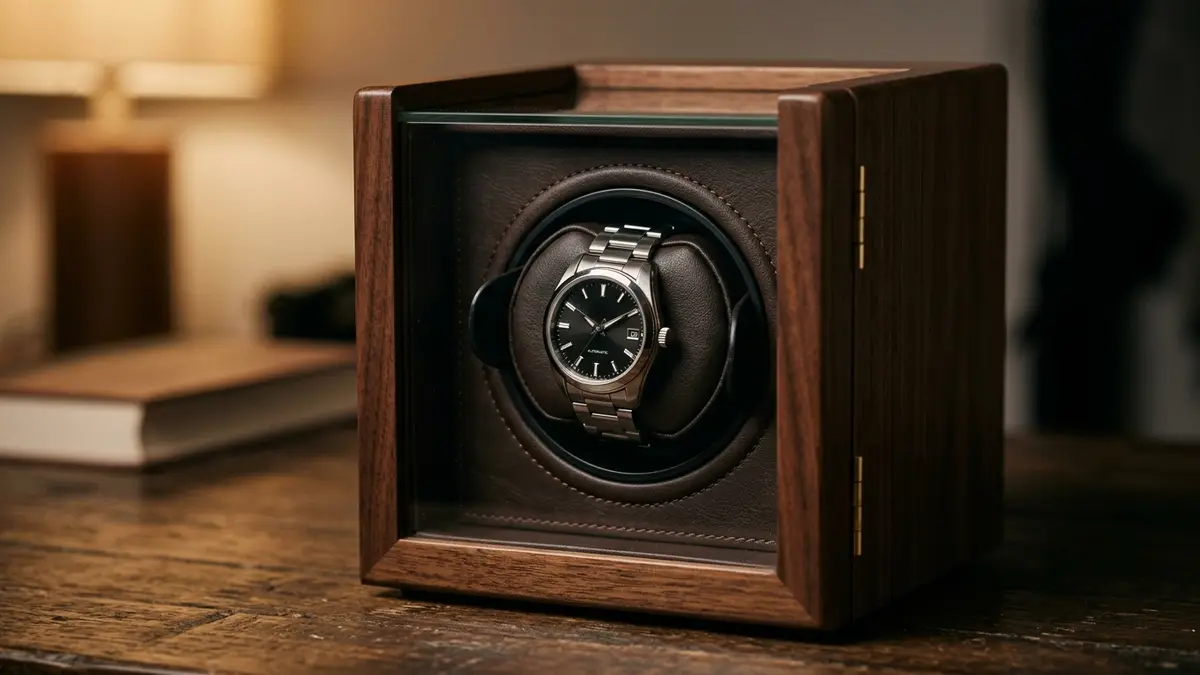
A watch winder rotates automatic watches to keep them wound when not worn.
Useful for
- Perpetual calendars, moonphases and complications that are tedious to reset
- Owners who rotate many automatics and want them ready
- Display and enjoyment
Not necessary for
- Simple time-and-date automatics — just set them when you pick them up
- Manual-wind, quartz or solar watches
- Collections worn in regular rotation
If you use one, set the correct turns per day (TPD) and direction for your movement (often 650–900 TPD; check the manufacturer's data), and choose a quality winder with shielded motors to avoid magnetism. Winders don't meaningfully wear out a movement, but constant running means service intervals apply regardless of wear.
Magnetism: the silent accuracy killer
Mechanical watches rely on a hairspring whose coils must "breathe" freely. If the hairspring becomes magnetised, its coils stick together, and the watch suddenly runs very fast — often gaining minutes per day. It's one of the most common reasons for a sudden change in accuracy.
Common magnetic sources
- Magnetic phone cases, wallet cases and tablet covers
- Laptop and tablet lids (magnets hold them shut), speakers and headphones
- Handbag and briefcase clasps
- Induction hobs, fridge magnets, magnetic knife racks
- Airport security scanners (usually weak)
- MRI machines (extreme — never take a watch near one)
How to check if your watch is magnetised
- Hold a small compass flat on a table.
- Slowly bring your watch close to it, rotating the watch.
- If the compass needle moves as the watch passes, the watch is likely magnetised.
Smartphone apps that measure timekeeping or magnetic fields can also give a hint, and any watchmaker can check in seconds.
How to demagnetise a watch
A watchmaker will do it for free or a small fee in seconds using a demagnetiser. Inexpensive consumer demagnetisers exist: place the watch on the device, press the button, and slowly lift the watch away while the button is held. Timekeeping should return to normal immediately.
Anti-magnetic watches
The ISO 764 standard requires resistance to 4,800 A/m (about 60 gauss). Some watches go much further: silicon hairsprings are non-magnetic, Omega's Master Chronometers resist 15,000 gauss, and designs like the Rolex Milgauss, IWC Ingenieur and Sinn models use soft-iron inner cages.
Travelling with watches
- Carry valuable watches in hand luggage, never checked baggage.
- Use a padded roll or hard case.
- Keep receipts or photos for customs — some countries may ask about expensive items.
- Consider a discreet watch in areas where theft is a concern.
- A GMT watch makes travel easier.
FAQ
Can a phone magnetise my watch?
A phone by itself is usually weak, but magnetic phone cases, chargers and accessories can magnetise a mechanical watch. Keep watches away from strong magnets.
Is it bad to leave an automatic watch stopped?
No. A stopped watch doesn't suffer harm; lubricants aren't damaged by sitting still. Just wind and set it when you want to wear it.