A GMT watch shows at least two time zones at once. It's the ultimate travel watch and one of the most practical complications ever devised — useful whether you fly weekly or simply call family overseas.
History
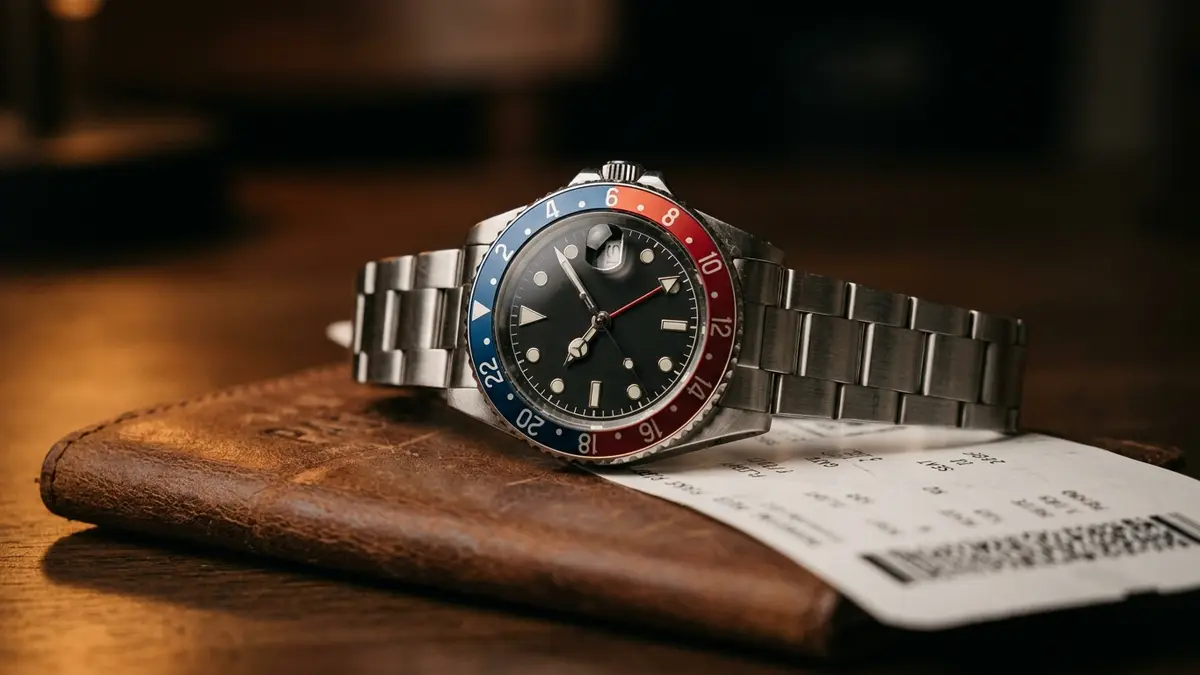
GMT stands for Greenwich Mean Time, once the world's time reference. In 1954, Rolex developed the GMT-Master with Pan American Airways so that pilots on the new long-haul jet routes could track home time and local time. Its red-and-blue bezel (day and night) — later nicknamed "Pepsi" — became one of watchmaking's most famous colourways. Glycine's Airman (1953) preceded it with a 24-hour dial.
The world timer, which shows all 24 time zones, was developed in the 1930s by Louis Cottier and adopted by Patek Philippe.
How a GMT works
- An extra GMT hand rotates once every 24 hours.
- It's read against a 24-hour scale on the bezel or the dial.
- Set the GMT hand to home time (e.g. 15:00 in New York) and the main hands to local time.
- With a rotating 24-hour bezel, you can read a third time zone by turning the bezel by the time difference.
Flyer vs caller (office) GMT
| Type | What you adjust independently | Best for | Examples |
|---|---|---|---|
| "True" / flyer GMT | Local hour hand jumps in 1-hour steps (date follows) | Travellers changing time zones | Rolex GMT-Master II, Tudor Black Bay GMT, Grand Seiko GMT |
| Caller / office GMT | GMT hand jumps independently | People who call other time zones from home | Seiko 5 GMT (NH34), many ETA 2893 watches, Tudor Black Bay Pro |
Both show two time zones. A flyer is more convenient when you land somewhere new — just jump the hour hand — and usually more expensive.
Other travel complications
- World timer — all 24 zones at a glance; see complications.
- Dual time — a subdial or second set of hands.
- GPS solar watches — automatically detect and set the local time zone; see connected watches.
Who GMT watches suit
Frequent flyers, anyone with family or colleagues abroad, remote workers across time zones, pilots and people who simply love the look. A steel GMT on a bracelet is also a superb one-watch choice — it's as versatile as a diver.
Iconic GMT watches
- Rolex GMT-Master II — "Pepsi", "Batman", "Sprite" and more.
- Tudor Black Bay GMT and Black Bay Pro.
- Grand Seiko Spring Drive GMT.
- Omega Seamaster Planet Ocean GMT.
- Glycine Airman — the original 24-hour pilot watch.
Best GMT watches by budget
| Watch | Approx. price | Type |
|---|---|---|
| Seiko 5 Sports GMT | ~$475 | Caller |
| Citizen Promaster GMT / Eco-Drive GMT | ~$300–$600 | Solar quartz |
| Microbrand GMTs (Lorier, Christopher Ward, etc.) | ~$500–$1,500 | Caller or flyer |
| Mido Ocean Star GMT / Certina GMT | ~$1,000–$1,500 | Caller |
| Tudor Black Bay Pro | ~$4,400 | Caller |
| Tudor Black Bay 58 GMT | ~$4,800 | Flyer |
| Rolex GMT-Master II | ~$11,000+ (retail) | Flyer |
FAQ
How do I read a GMT watch?
The normal hour and minute hands show local time. The GMT hand points to a 24-hour scale showing your second (often home) time zone. Turning the bezel lets you read a third zone.
Is a GMT a good everyday watch?
Absolutely. It's as robust and versatile as a diver, and the second time zone is surprisingly useful even when you're not travelling.