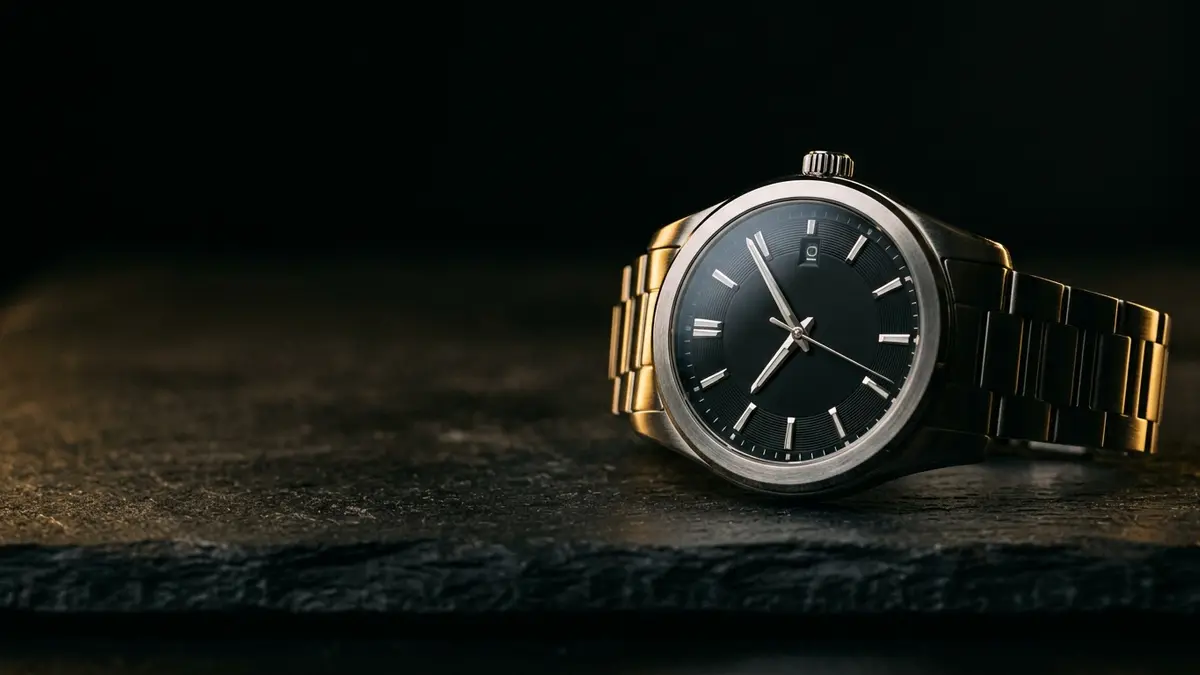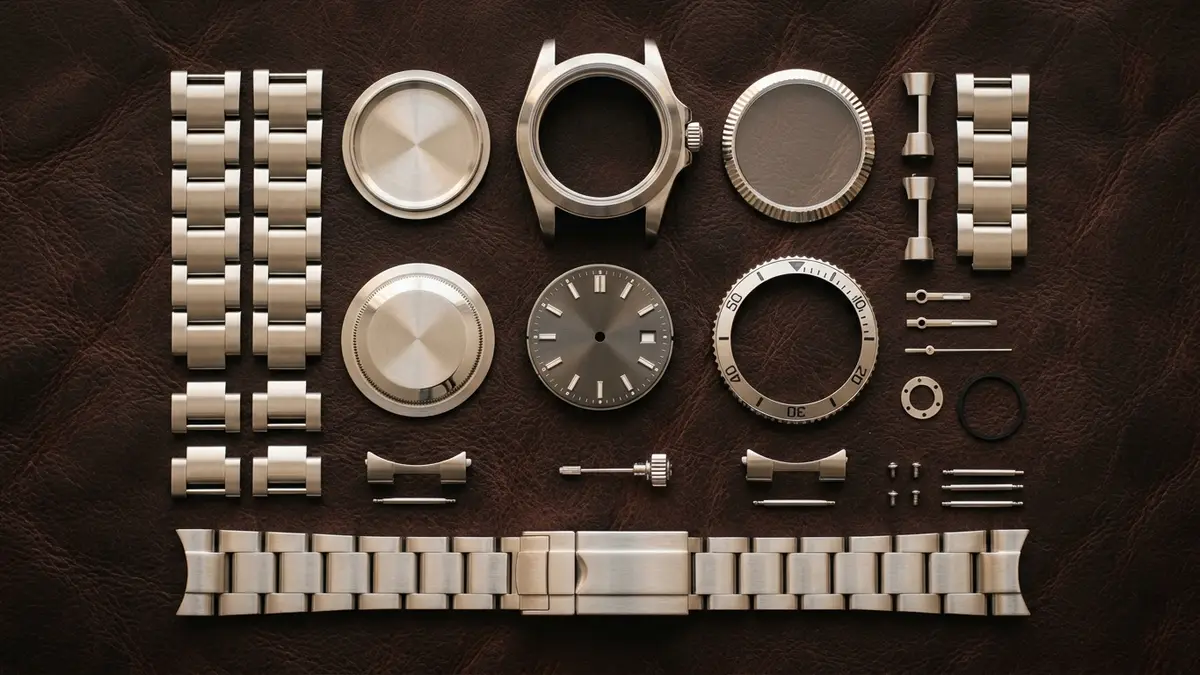
Before you can compare two watches, read a spec sheet or talk to a watchmaker, you need the vocabulary. Every wristwatch — from a $20 digital Casio to a six-figure Patek Philippe — is built from the same basic family of parts. Once you know what they are called and why they matter, product pages suddenly make sense and you can spot quality (or corner-cutting) in seconds.
The case: the watch's body
The case is the metal (or ceramic, titanium, resin) housing that protects the movement. It determines most of what you feel on the wrist: size, weight and comfort. When a brand quotes a watch as "40 mm", it means the case diameter measured across, usually excluding the crown.
Three case measurements matter more than any other:
- Diameter — width across the case. Most men's watches sit between 36 and 44 mm.
- Thickness — height from caseback to top of the crystal. Under 10 mm feels slim and slides under a shirt cuff; over 14 mm feels chunky.
- Lug-to-lug — distance from the tip of the top lugs to the tip of the bottom lugs. This decides whether the watch overhangs your wrist, and it is often more important than diameter. Our watch size guide explains why.
Case finishing is one of the quickest ways to judge quality. Look for crisp transitions between brushed (satin, fine parallel lines) and polished (mirror-like) surfaces. Cheaper watches often have one uniform finish; better ones alternate the two with sharp edges between them.
Lugs
The lugs are the four "horns" that stick out from the case and hold the strap or bracelet with spring bars. Their length and curvature have a huge effect on how a watch wears. Short, downward-curving lugs let a 42 mm watch fit a modest wrist; long, straight lugs can make a 39 mm watch feel oversized.
Caseback
The caseback is the underside of the case. It can be solid (often engraved), screw-down (common on divers for better water resistance) or exhibition (a sapphire window that shows the movement). An exhibition back is great for mechanical watches with nicely decorated movements; it is pointless on quartz.
The dial and hands
The dial (or "face") is what you read. It carries the brand name, the hour markers (called indices) and sometimes subdials, a date window or text such as the water resistance rating.
- Indices can be printed, applied (small metal pieces fixed to the dial) or numerals. Applied indices catch light and signal a higher level of craftsmanship.
- Lume is the luminous paint on hands and markers (usually Super-LumiNova) that glows after exposure to light — essential on dive and field watches.
- Dial textures include sunburst (radiating lines that change colour in light), matte, guilloché (engine-turned patterns), enamel and more.
The hands are the hour, minute and seconds hands, plus any extra hands for complications like a GMT or chronograph. Hand shapes have names — sword, dauphine, baton, Mercedes, snowflake, cathedral — and each suits a style. A good test of quality: do the hands reach the markers they point to? A minute hand that stops short of the minute track is a small but telling cost-cut.
The crystal: the watch's window
The transparent cover over the dial is called the crystal. There are three types:
| Crystal | Scratch resistance | Shatter resistance | Typical price level |
|---|---|---|---|
| Acrylic (Hesalite, Plexiglas) | Low — but scratches polish out | Excellent — flexes rather than shatters | Budget and vintage-style |
| Mineral (incl. Seiko Hardlex) | Medium | Good | Budget to mid-range |
| Sapphire | Very high (9 on the Mohs scale) | Can chip or crack on a hard edge impact | Mid-range and above |
Many sapphire crystals have an anti-reflective (AR) coating that removes glare. Read more in our guide to watch materials and crystals.
The bezel
The bezel is the ring surrounding the crystal. On a dress watch it is a simple polished ring. On tool watches it becomes an instrument:
- Dive bezel — rotates one way only (unidirectional), marked 0–60 minutes, used to time a dive safely.
- GMT bezel — marked 0–24 hours, used with a fourth hand to track a second time zone.
- Tachymeter — a fixed scale on chronographs for calculating speed over a known distance.
- Count-down, compass and slide-rule bezels — found on specialist pilot and field watches.
A good rotating bezel clicks crisply with no wobble ("bezel play"). It is one of the first things enthusiasts test in a shop.
The crown and pushers
The crown is the knurled knob on the side of the case. Depending on its position, it winds a mechanical movement, sets the date and sets the time. On water-resistant watches, the crown often screws down onto a threaded tube to seal the case — always screw it back in after use.
Pushers are the buttons found on chronographs (to start, stop and reset the stopwatch) and sometimes to adjust the date or other functions. Crown guards — metal shoulders on either side of the crown — protect it from knocks on sports watches.
Inside: the movement
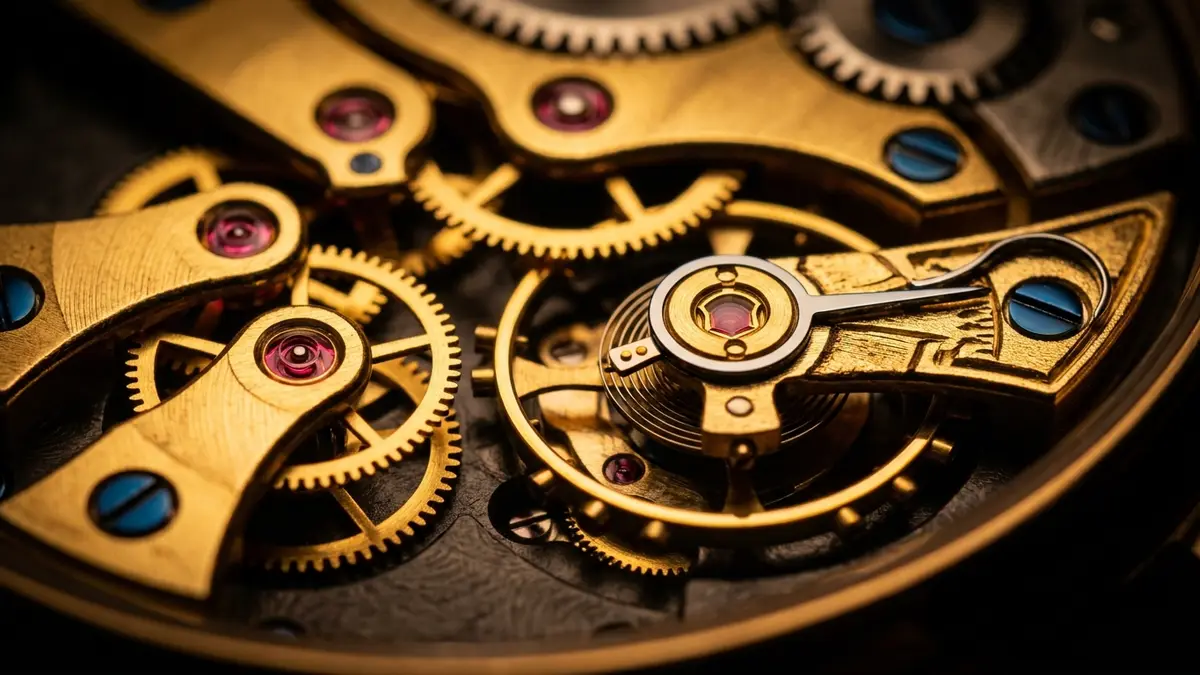
The movement (also called the calibre or caliber) is the engine that keeps time. It can be mechanical (powered by a wound spring) or quartz (powered by a battery and regulated by a vibrating quartz crystal). This is the single most important choice when buying a watch, and we cover it in depth in mechanical vs quartz.
Also hidden inside are gaskets — rubber seals at the caseback, crown and crystal that keep water and dust out. They age and should be replaced during servicing, which is why water resistance is never permanent.
Strap, bracelet and clasp
The strap (leather, rubber, fabric) or bracelet (metal links) attaches to the lugs with spring bars. The distance between the lugs — lug width, typically 18–22 mm — tells you which straps fit. Bracelets come in famous styles such as the three-link Oyster type, the five-link Jubilee type, mesh (Milanese) and integrated designs flowing directly out of the case.
The clasp matters too. Look for:
- Solid end links (the pieces touching the case) rather than folded sheet metal.
- Screwed links instead of friction pins — easier and safer to resize.
- Micro-adjustment in the clasp, so you can loosen the bracelet a few millimetres on hot days.
Straps can completely change the character of a watch — see our strap guide.
Quick reference: how to read a spec sheet
Now that you know the parts, a typical specification reads easily:
"40 mm stainless-steel case, 11.9 mm thick, 47 mm lug-to-lug, 20 mm lug width. Sapphire crystal with AR coating. Unidirectional 60-minute bezel. Screw-down crown, 200 m water resistance. Automatic movement with 70-hour power reserve."
Translated: a medium-sized, reasonably slim dive-style watch that fits most wrists, is scratch-resistant, can be swum and snorkelled with, and will keep running for almost three days if you take it off. For every term not covered here, see our watch glossary.
FAQ
What is the most important part of a watch?
The movement determines accuracy, maintenance and much of the price, but for day-to-day satisfaction the case dimensions (especially lug-to-lug) matter just as much because they decide comfort and fit.
What is the difference between a bezel and a crystal?
The crystal is the transparent cover over the dial; the bezel is the ring that surrounds the crystal. Bezels can be fixed or rotating and may carry scales for timing or time zones.
What does lug width mean?
Lug width is the gap between the lugs where the strap fits, measured in millimetres. You need a strap of exactly that width — typically 18, 20 or 22 mm.