Pilot watches were built for one job: to be read instantly in a vibrating, dimly lit cockpit by someone wearing gloves. That brief created one of the most recognisable and enduring watch styles — large, supremely legible and full of adventure.
History
In 1904, Brazilian aviator Alberto Santos-Dumont asked his friend Louis Cartier for a watch he could read without taking his hands off the controls. The result, the Cartier Santos, is often called the first pilot's wristwatch. Through the 1920s and 30s, Longines worked with Charles Lindbergh on the Hour Angle navigation watch.
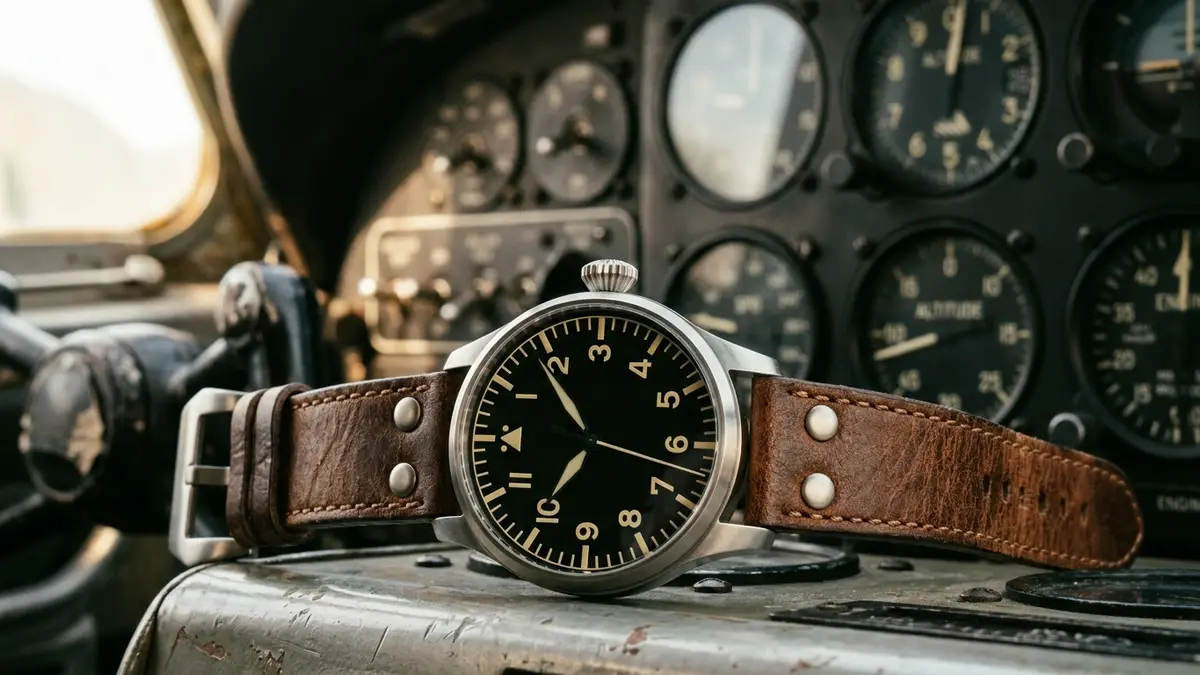
The archetypal pilot watch arrived in World War II: the German Beobachtungsuhr ("B-Uhr" or "Flieger"), made by A. Lange & Söhne, IWC, Laco, Stowa and Wempe for navigators. Huge 55 mm cases, bold numerals, a triangle with two dots at 12 and an oversized "onion" crown were all designed for use over flight jackets. After the war, Breitling's Navitimer (1952) added a slide-rule bezel for flight calculations, and pilot chronographs flourished.
Characteristic features
- Maximum legibility — high-contrast black dial, large white Arabic numerals, sword or propeller hands.
- Triangle marker at 12 — for instant orientation.
- Type A vs Type B dials — Type A shows hours 1–12 with minutes as dots; Type B puts minutes on the outer ring and hours on an inner ring (used by navigators).
- Oversized crown — easy to use with gloves.
- Large case — traditionally 40 mm and up.
- Riveted leather strap — long enough to go over a flight suit.
- Anti-magnetic protection in some models, like IWC's soft-iron inner cage.
- Slide-rule bezel or chronograph on some pilot models.
Who pilot watches suit
Pilot watches look great with casual and smart-casual wear — leather jackets, bombers, knitwear, chinos and jeans. Because they're large, they suit medium to larger wrists best, although 38–40 mm versions now exist for smaller wrists. They're an excellent travel watch, especially in GMT variants. Less suited to formal wear.
Iconic pilot watches
- Cartier Santos — the aviation original.
- IWC Big Pilot's Watch and Mark series — modern Flieger royalty.
- Breitling Navitimer — slide-rule chronograph icon.
- Longines Spirit and Lindbergh Hour Angle.
- Zenith Pilot — the brand holds the trademark on the word "Pilot" on a dial.
- Laco and Stowa Flieger — makers of original WWII B-Uhr, still producing faithful versions.
- Bell & Ross BR 03 — square cockpit-instrument design.
Best pilot watches by budget
| Watch | Approx. price | Why |
|---|---|---|
| Seiko 5 / Citizen pilot-style quartz or solar | ~$150–$300 | Affordable Flieger looks |
| Laco Pilot Aachen or Augsburg | ~$450 | Authentic German Flieger heritage |
| Stowa Flieger Classic | ~$1,000 | Original WWII maker, superb value |
| Hamilton Khaki Aviation | ~$900 | 80-hour reserve, Swiss |
| Longines Spirit | ~$2,500 | COSC chronometer |
| IWC Pilot's Watch Mark XX | ~$5,000+ | The luxury benchmark |
| Breitling Navitimer | ~$9,000+ | The slide-rule chronograph |
Buying tips
- Check lug-to-lug: many pilot watches have long straight lugs and wear larger than their diameter.
- If you want the WWII look, choose a Type A dial for simplicity or Type B for authenticity.
- A pilot chronograph or GMT adds practical function for travel.
FAQ
What is a Flieger watch?
Flieger means "flyer" in German. It refers to the WWII-era German navigator's watch style (B-Uhr) with a black dial, large numerals, a triangle at 12 and a big crown.
Do real pilots still use pilot watches?
Modern cockpits have digital instruments, but many pilots wear a watch as a backup and for tracking multiple time zones — often a GMT or chronograph.